If ever a whānau embodied the E Tū Whānau vision of strong, safe and prosperous whānau, active within their community, living with a clear sense of identity and cultural integrity and with control over their destiny, it’s the Mānihera whānau.
Five years ago, they decided to protect their tamariki from the effects of intergenerational trauma by embracing te ao Maori in all aspects of their lives.
The adults pooled their resources and moved together into two houses. They began home schooling their tamariki and learning te reo together, committing to speaking it as their first language.
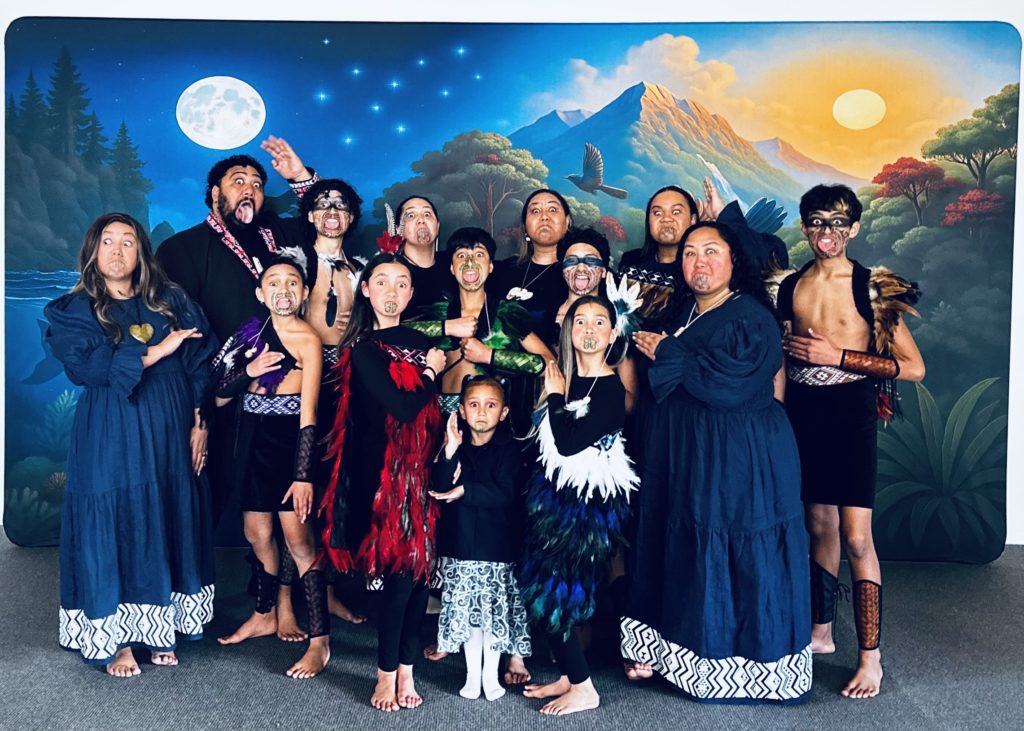
Fast forward to 2026. The 16-strong Mānihera whānau are now known throughout Te Tai Tokerau and Muriwhenua for their mokopuna-led, waiata and kapa haka-infused performances in schools, on marae and at community events. Their soaring vocals and joy-filled stage presence have delighted audiences and visiting dignitaries both here and overseas.
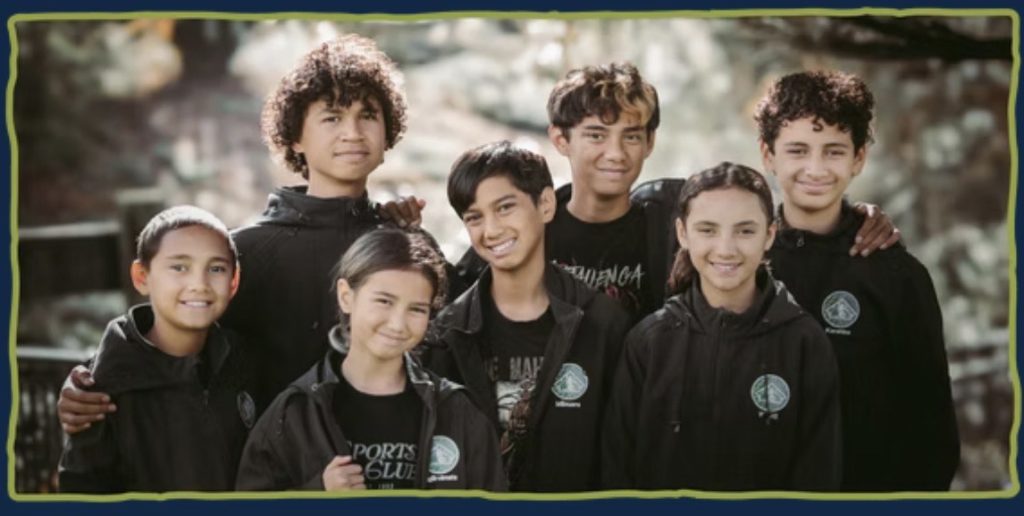
The whānau are the stars of Hīkina te Mānuka, a 10-part reality series celebrating their te ao Māori lifestyle. They’ve also just recorded their first album of original waiata and te reo versions of country music classics alongside another joy filled kiwi family band, the Harmonic Resonators and they’re on Spotify.
The Mānihera whānau have indeed taken control of their destiny. In doing so, they’ve developed a successful performance-driven, educational business that includes – and sustains – them all.
What’s it like to be a child in the Mānihera whānau?
Jasmine Mānihera is a visionary. She’s the second oldest of her six siblings but the oldest of those living together with their rangatahi. Five years ago, she graduated from a year-long total immersion te reo course. Her world view expanded and she wanted to share her new knowledge and insights with her loved ones.
At the time, Jasmine and her two sisters, Raiha and Tere, their brother, Hāne, their sister-in-law, Pērina, and their whāngai sister, Hinemoa, were all living separately in rental accommodation. They had nine children aged one to 19 years between them.
Jasmine gathered them together and asked a simple question: ‘What is it like to be a child in our whānau?’
The Mānihera siblings knew their tamariki were loved, well clothed and fed, with roofs over their heads. However, when they took a deep, honest look into how their children were developing holistically, the picture was not so healthy.
Raiha remembers it as a challenging kōrero.
“Our tamariki had witnessed abusive relationships, alcoholism, drug abuse, violence and quite a lot of passive aggressive behaviour.
We all knew that we wanted better for them. So, we looked at our goals, at what we wanted for our tamariki and for ourselves. We realised that if we were all to succeed, we had to do something drastic.”
That’s when Jasmine suggested they pool their resources, share expenses and live as a hapū.
“We had some awesome robust conversations about it. We found common ground, took a giant leap of faith and never looked back.”
Building on the best of the past
The Mānihera siblings had ample skills and experience between them to successfully home school all their tamariki. They’d grown up doing kapa haka with their father. Their mother, who now lives with them, is a school principal. Jasmine is a high school teacher, and Raiha has early childhood and yoga teacher experience.
They started by learning te reo together.
Their rangatahi picked it up easily and within a couple of months were speaking it as a first language. The pakeke had to work hard to keep up but they loved the challenge.
“We made learning te reo fun. Everything was turned into a game. Life was full of joy and excitement,” Raiha said.
With that building block of their te ao Māori lifestyle in place, they turned their attention to making a living that would support their combined household.
Their collective experience as educators, their kapa haka expertise and love of music became the passport to financial independence for the Mānihera whānau.
They now run wānanga supporting other whānau to reconnect more deeply with te ao Māori. They also take a beautifully crafted musical roadshow into mainstream kura; tailored performances incorporate traditional stories that teach tamariki about personal safety.
“We bring our ancient creation stories of Atua Māori and our tūpuna to show our tamariki why it is important to protect themselves from harm, and to not harm others. The main message in our show is ‘He tapu te tinana, he taonga te tangata’.”
Along came Aunty Del
They were a year into that project when the Mānihera whānau met E Tū Whānau Kaitohu Matua, Adele Harrison at a community sports event in Hokianga.
“I heard this beautiful singing. It was uplifting for everyone around me. Later, they came by to ask about our resources and told me their story. I saw immediately that they were on a transformational journey that aligned with our kaupapa. They’re just beautiful,” says Adele. “They transform communities just by their presence.”
That transformational experience – and aroha – goes both ways.
“Aunty Del has been a constant support from the time we met, sharing our kaupapa and offering practical advice when we ask for it.
She’s helped us with business skills. She’s shown us how to navigate funding applications and financial reporting, and she connects us to the wider community at every opportunity.
Our tamariki love her. We all do,” says Raiha.
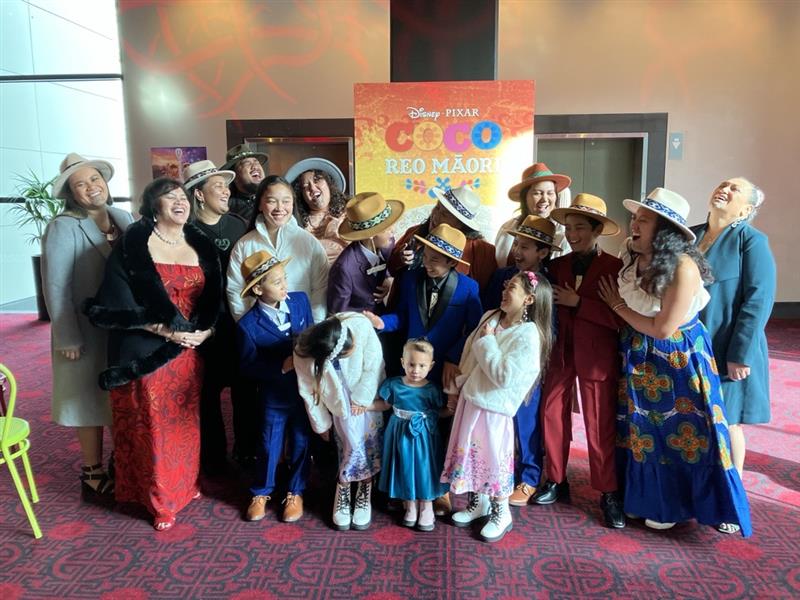
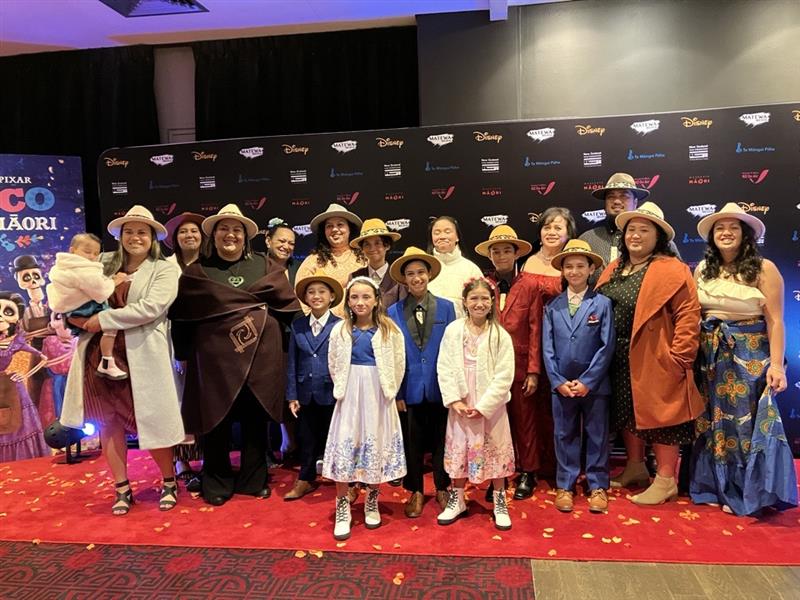
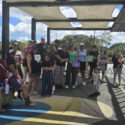
Adele Harrison with the Mānihera tamariki and pakeke at the premier of Disney’s Coco Te Reo Māori celebrating Manuera Mānihera’s debut as Miguel, the main character voice-over.
Raiha says that the E Tū Whānau kaupapa itself has helped them name what they do.
“Yes, we’re breaking toxic cycles, but we asked ourselves, ‘What does that really mean?’”
We realised that by living and loving our Māori world 24/7, we were healing ourselves. By creating our own mahi, we are offering insights and experience to empower our people with the knowledge that each one of us has everything we need within us to live our best lives,” says Raiha.
“We’re comfortable with who we are. We know our culture and our tikanga. We know it’s great to be Māori.”